Monday, November 19, 2012
Apple Cider Bread
I was first introduced to the concept of apple cider bread a few weeks ago when a loaf of it found its way from the local deli to the break area at work. Somewhere between snack and dessert (and OK I'll admit it; I've had it for breakfast), this is one of those dense, moist breads that could no doubt easily and deliciously transfer into muffin form.
I carry the curse of the label reader, though, and by the eleventh unpronounceable item on the list, I realized that despite the innocent clear plastic wrap and the cutesy little sticker trying hard to sounds like someone's actual grandmother rather than a brand name, this was just another edible food-like substance. It was a shame though. It really was good.
Deconstructing the apple cider bread and rebuilding it with natural ingredients proved a challenge in an unexpected way: all the really out there sounding stuff I decided were probably just preservatives and could be omitted altogether. What really got me was the vagueness of the ingredients. Things like "spices," "sweeteners," "flavoring," and "leavening." How does that count as an ingredients list? Why don't they want me to know what's in their bread? Is it because it's Grandma's Super Secret Recipe that's been passed down for generations, or is it just because it's made with whatever's cheapest on the market that day?
I think I just answered my own question. Anyway, here's my take on a great dessert bread with a New England touch. Happy Thanksgiving, everyone! Let me know what you're eating this week in the comments section!
Ingredients:
1 cup whole wheat flour
1 1/2 cups unbleached flour
1 1/4 teaspoons baking soda
1/4 teaspoons cream of tartar
1/4 teaspoon salt
1/4 teaspoon nutmeg
1/2 teaspoon cinnamon
3 eggs
1/2 cup (8 tablespoons) butter, melted
1/2 cup maple syrup
1 teaspoon vanilla extract
1 1/2 cups apple cider
Directions:
1. Preheat oven to 350 and grease the bottom and sides of a loaf pan.
2. Whisk together flour, baking soda, cream of tartar, salt, nutmeg, and cinnamon in a small bowl.
3. In a large bowl, mix together butter and sugar, then add eggs one at time, followed by maple syrup, vanilla extract, and cider. Blend well.
4. Slowly mix in the dry ingredients until the mixture has a smooth but slightly viscous consistency, a little thicker than cake batter.
4. Bake for about 45 minutes, until a tester comes out clean.
5. Let cool and then gently detach the cake from the edges of the pan with a knife. Flip it over onto a plate, then reflip to serve.
Wednesday, November 14, 2012
GMO Labeling Proposition Loses California Vote
Call me an idealist, but I was genuinely surprised when
Proposition 37 failed to pass on November 6th. An item on the California
ballot, it would have mandated the labeling of grocery items that contained
genetically modified organisms. Not banned them or taxed them or anything like
that; just said that consumers deserve to know what they're consuming.
I thought that, as a species, our thirst for knowledge could
overcome anything. I mean, we're a society that can't go two hours without
checking the weather, the traffic, Kim Kardashian's Twitter feed, you name it.
We're obsessed with up-to-date information on just about everything. So how did
a majority of people at the polls in California of all places manage to take a
look at that ballot and say, "Eh. I don't really want to know what I'm
eating. Let's keep a little mystery alive?"
The answer to that question can pretty much be boiled down to
money, as so many things can. Combined with a little disorganization and
naivite on the part of the "Yes" campaign, the immense (some sources
say up to $45 million!) amount of money spent by Monsanto, Coca-Cola, and a
handful of the other usual suspects managed to buy enough negative advertising
to swing things their way.
But if there's nothing wrong with GMOs, why bother? If you have
$45 million to spend, why not spend it on publicizing how great GMOs are and
how you should buy them even if they are labeled as such? Or better yet, they
could spend that $45 million dollars on, I don't know, research proving that GMOs aren't bad for us. No
matter what the truth is about these foods, it’s important to try to find the truth, and the fact that the
companies that sell them are not only trying to hide the truth from consumers,
but are actually going out of their way not to find out the truth for themselves is
alarming.
But now for the good news: the proposition made it onto the ballot.
It got talked about. It's in the public eye, at least somewhat. And yes, it was
voted down, but it was voted down 53% to 47%. That's pretty darned close. And
from what I've read in the aftermath of all this is that the pro-labeling
campaign is learning from its mistakes, gearing up for similar fights in other
states using a different marketing strategy and better consolidation of
funding.
So what do you think? If you live in California, how did you vote
on Proposition 37? Why did you choose the way you did? Those of you everywhere
else, did you know it was on the ballot or is this the first you're hearing
about it? How would you vote if something similar came up in your state? Let me
know in the comments section, and while you mull over your response, enjoy this amazing sarcastic rap video explaining what you need to know about
genetic alteration and our food.
Wednesday, November 7, 2012
Harvest Dinner
Remember my mom's guest post from the beginning of the summer about her first experience as a CSA member? Apparently she's been saving up a bunch of the spoils in the freezer, and last weekend when I was down in Connecticut we had what can only be described as a warm-up for Thanksgiving. In celebration of the end of the CSA run and the summer season it stands for, as well as two of my mother's friends' kitchen remodeling forcing them out of their home, we gathered around for a locally sourced and fall themed feast.
| It got pretty crowded in the oven. |
| You know it's fancy if it's a two fork kind of night. |
| That's not corn on the left; I don't know what you're talking about. |
| Turkey, sweet potatoes, apple cider. I'd forgotten how delicious fall can be. |
In true harvest fest fashion, overeating ensued, but it didn't stop anyone from indulging in dessert. This fruit crumble is at its best fresh from the oven with a little vanilla ice cream on top. Its also a good taste of something different to bust out at Thanksgiving dinner. You know, to vary things up a little if there are too many pies. Ours featured peaches, blueberries and raspberries, but use whatever you've got in your freezer from picking season!
Ingredients:
5 cups fruit
3 tablespoons maple syrup
1/4 cup spelt flour
1/2 cup old fashioned rolled oats
1/2 cup packed brown sugar
1/4 teaspoon nutmeg
1/4 cup grass-fed butter
1/4 cup chopped pecans
Directions:
1. Put fruit in a 2 quart baking dish and stir in the maple syrup.
2. In a separate bowl, combine oats, brown sugar, spelt, and nutmeg.
3. Cut in the butter, so that the mixture resembles coarse crumbs.
4. Stir in the nuts, and sprinkle topping over fruit.
5. Back at 375 for 35-40 minutes.
Tuesday, October 23, 2012
Apple Cranberry Muffins
One of the few perks to the change of seasons is that it's no longer too hot to bake. When the October wind starts causing my ancient windows to rattle around in their frames and give a spooky chill to the kitchen, there's no better fix than to preheat the oven to 375 and whip up a fall treat. Featuring apples and cranberries, these muffins make a great breakfast to get you going on a morning with bite in the air.
Ingredients:
1 cup organic unbleached all-purpose flour (I like King Arthur brand)
1/2 cup organic whole wheat flour
1/3 cup organic granulated cane sugar
1 teaspoon baking soda
2 teaspoons cinnamon
1 teaspoon nutmeg
3 free range eggs
1/2 cup olive oil
1/4 cup maple syrup
1/ teaspoon pure vanilla extract
1 organic apple, diced (I used a Courtland, which has some tang. Substitute a Golden Delicious if you want more sweetness.)
1 cup organic dried cranberries, chopped
Directions:
1. Place the rack in the center of the oven. Preheat over to 375. In a large bowl, mix flours, sugar, baking soda, cinnamon, and nutmeg.
2. In a smaller bowl, mix together eggs, oil, maple syrup, and vanilla until well blended. Pour this mixture over the dry ingredients. Mix lightly with a spoon. Then add the apples and cranberries and stir well to combine.
3. Grease a muffin tin with olive oil or batter, and fill the cups about 1/3 of the way. Bake for 20-25 minutes, until tester comes out clean.
4. Remove from oven and gently go around the edge of each muffin with a knife to separate it from the tin. They should pop out smoothly.
Monday, October 15, 2012
Blog Action Day 2012: The Power of We
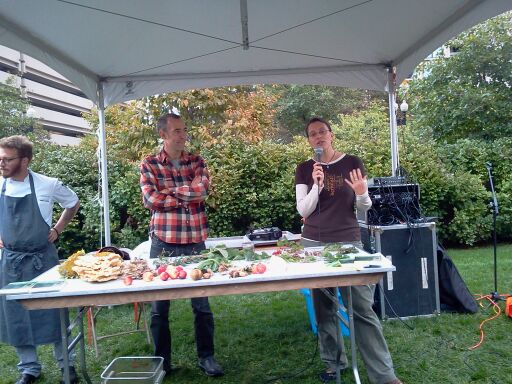
A phrase like "the power of we" might call to mind images of political uprisings at first; flags waving in the streets, guillotines, mocking jays, that kind of thing, but the truth is that the power of a group of people to bring about change, for the better or for the worse, is evident all the time in small ways.
When we pressure each other into staying out late on a work night, or when we band together to stand in the way of letting a friend make a terrible decision about their hair color, we're proving the point that if enough people care enough about something, they can not only make it happen, but make it seem like it should happen.
It's the same way with food. The millions of people every week who just want a quick hamburger are, whether they mean to or not, telling McDonald's and its suppliers that it's OK to produce and sell food in an unsustainable manner.
Likewise, every time we make the simple choice to get informed about where our food comes from and literally put our money where our mouth is, we're having an impact, no matter how small, on how available the types of foods we want will be in the future. McDonald's might not notice if you stop going there, but your local farm stand certainly will.
![]() |
| It really does taste different; very rich and creamy. I'll bet it makes great hot chocolate. |
![]() |
| On a cold day like last Sunday was, there's nothing like a free sample of a hot meal. |
![]() |
| These fish are napping after a long day at the festival. |
![]() |
| A tutorial on the medicinal properties of some lesser-known plants |
Tuesday, October 9, 2012
Hey, What Happened to the Farm Bill?
Remember a few weeks ago when the Farm Bill was all over the news? I had kind of assumed that it had passed when I wasn't paying attention, but it turns out they just postponed making a decision about it, probably until after November's presidential election.
If you're not familiar with it, the Farm Bill comes up in Congress once every five years and dictates agricultural policies like food safety, international trade, environmental conservation, all kinds of stuff. Our current bill expired on September 30th, and has apparently been sitting around Capitol Hill twiddling its thumbs and waiting for someone to remember it ever since.
In the meantime, there was a suspicious absence of any mention of such a bill at the first presidential debate last week. I know, I know, there are more debates to come. We don't have time to squeeze everything into an hour and a half. But since health care plans and their costs were certainly discussed to death, it seems like the issue of what Americans eat and how we get it maybe deserved a word or two. After all, food is our most basic preventative medicine.
With families struggling to provide their children with basic nutrition, theories floating around that Alzheimer's is a form of diabetes, and the seriously alarming rumors that we may be facing a bacon shortage very soon, our agricultural system is something we can't afford to put on the back burner.
Unfortunately, what attention has been paid to the Farm Bill so far is not promising in the least. According the latest news I could find, things are looking pretty bleak for those of us wary of genetically modified crops. Three provisions in the current draft of the farm bill put far too much power in the hands of the USDA, which already has quite enough, if you ask me. Under the bill as it currently reads, the Department of Agriculture would have sole power to regulate how many (unlabeled, I'm sure) GMOs make their way into our food system, while simultaneously preventing the Department from accepting any outside money for researching whether GMOs are, you know, dangerous. The best part, though, is definitely the ticking time bomb clause that states that if the people over at the USDA put off making a decision about any given GMO crop for long enough and miss their deadline, that particular food will be approved by default.
Seriously? It's no wonder they're calling this group of provisions the "Monsanto Rider."
It doesn't stop there, of course. There's all kinds of controversy on the table about how much funding should be allotted to nutritional assistance for low-income families, (Spoiler alert: it's almost definitely going to be less than the current budget.) not to mention what, if any, changes will be made in the policy regarding our increasingly precarious way of subsidizing commodity crops and artificially boosting demand for them at the cost of our economy and our health.
So what do you think? Is it a good thing that they're putting off deciding on the Farm Bill until we know who's going to spend the next four years in the White House? Would a second term Obama deliver on his 2008 promise to label GMOs? Are we going to hear anything about this issue in the upcoming debates? Discuss.
Thursday, October 4, 2012
Post-Modern Cheesecake
It's no secret that I love cheesecake, and judging from the fact that it only took my last cheesecake related recipe a couple of weeks to become the #3 most viewed post on this blog ever, I guess you do too.
My fellow food blogger Andrew Wilder of Eating Rules is posing a challenge to us this month that he calls October Unprocessed, asking us to really think about not just what's in our food, but how the ingredients get there, and what they, in turn, are made of. It's kind of like Corn-Free July, but even more annoying.
The word "deconstructionism" comes to mind a lot when I'm making my grocery lists during these challenges. To know whether or not something counts as "unprocessed," you have to know what goes on at every level of making it. And that knowledge in itself makes you a more responsible consumer. It empowers you to make informed choices about your priorities when it comes to your own health. What could be more important?
Sometimes the deconstruction is simple. Has this apple been processed? No. Has this Pop-Tart been processed? Yes.
But it doesn't take long to arrive at something whose answer doesn't come so quickly. Something for which you have to strip away some layers before you can find the truth. But once you do, you understand that dish better than you did before, and you can put back together again in a way that makes it just a little bit different than it was before. Hopefully for the better.
Take cheesecake, for example. Before I got into any of this health food stuff and I just wanted as few steps as possible standing between me and a delicious dessert, I found a quick, simple, cheesecake recipe in a cookbook that my roommate had, and that recipe is still the basis for all the cheesecakes I make. It has just four ingredients: cream cheese, sugar, eggs, and graham cracker crusts.
The first three ingredients should be pretty easily obtainable at your local health food store. Pasture-raised cream cheese (I like Organic Valley brand) and free range eggs are fairly straightforward. As for sugar, I usually settle for organic cane sugar, but if even that's too processed for you, try maple sugar. (I've experimented with liquid-based sweeteners, but then consistency starts to become an issue. Let me know if you have any success.)
The real fun comes with the graham cracker crust, though. When I set out to make my first corn-free cheesecake, I realized I couldn't use the standard pre-baked crust that you buy at the supermarket already in a conveniently disposable pie tin anymore. So what to do?
Luckily, a recipe for pretty much anything is just a Google search away, and it was mere seconds before I found instructions for a graham cracker crust at AllRecipes.com. The first time I made that one I accidentally used way too much butter, a mistake I've been duplicating on purpose ever since. The rich flavor, the crunch...it's OK to indulge every once in awhile. With the cost of these crazy hippy ingredients, it's definitely not something you'll have every day, and besides, at least there are no trans fats. (Trans fats are still bad for you, right? I haven't heard anything about them recently.)
But of course, the number one ingredient in a graham cracker crust is, well, graham crackers. Which leads me to an overwhelming question: what the hell is a graham cracker?
Seriously. They come in a box. They have a distinctive taste, but I couldn't tell exactly what that taste is, beyond "graham cracker." I guess it's akin to "animal cracker," but those probably don't exactly grow on a tree either. So it was back to Google again. This time searching for "graham cracker recipe." I was pleased to find one on a food blog I already knew and loved, Smitten Kitchen.
So that's three. THREE! recipes and a ridiculous amount of prep time for one simple dessert. But let me tell you, it's worth it. Going the extra mile will result in the most delicious cheesecake you've ever had. You'll find yourself getting invited to parties just because people are hoping you'll bring it. And the best part? The reconstruction isn't done! I make a cheesecake every couple of months and I've never made the same one twice. Add chocolate to the graham cracker crust, put strawberries on top, make your own whipped cream as a topping. This is one dish that will never get old.
What other foods do you find yourself over-analyzing when you try to make them at home in a healthier-than-usual form? Is there anything else you'd like to be able to make in a minimally processed way? Give me a challenge!
My fellow food blogger Andrew Wilder of Eating Rules is posing a challenge to us this month that he calls October Unprocessed, asking us to really think about not just what's in our food, but how the ingredients get there, and what they, in turn, are made of. It's kind of like Corn-Free July, but even more annoying.
The word "deconstructionism" comes to mind a lot when I'm making my grocery lists during these challenges. To know whether or not something counts as "unprocessed," you have to know what goes on at every level of making it. And that knowledge in itself makes you a more responsible consumer. It empowers you to make informed choices about your priorities when it comes to your own health. What could be more important?
Sometimes the deconstruction is simple. Has this apple been processed? No. Has this Pop-Tart been processed? Yes.
But it doesn't take long to arrive at something whose answer doesn't come so quickly. Something for which you have to strip away some layers before you can find the truth. But once you do, you understand that dish better than you did before, and you can put back together again in a way that makes it just a little bit different than it was before. Hopefully for the better.
Take cheesecake, for example. Before I got into any of this health food stuff and I just wanted as few steps as possible standing between me and a delicious dessert, I found a quick, simple, cheesecake recipe in a cookbook that my roommate had, and that recipe is still the basis for all the cheesecakes I make. It has just four ingredients: cream cheese, sugar, eggs, and graham cracker crusts.
The first three ingredients should be pretty easily obtainable at your local health food store. Pasture-raised cream cheese (I like Organic Valley brand) and free range eggs are fairly straightforward. As for sugar, I usually settle for organic cane sugar, but if even that's too processed for you, try maple sugar. (I've experimented with liquid-based sweeteners, but then consistency starts to become an issue. Let me know if you have any success.)
The real fun comes with the graham cracker crust, though. When I set out to make my first corn-free cheesecake, I realized I couldn't use the standard pre-baked crust that you buy at the supermarket already in a conveniently disposable pie tin anymore. So what to do?
Luckily, a recipe for pretty much anything is just a Google search away, and it was mere seconds before I found instructions for a graham cracker crust at AllRecipes.com. The first time I made that one I accidentally used way too much butter, a mistake I've been duplicating on purpose ever since. The rich flavor, the crunch...it's OK to indulge every once in awhile. With the cost of these crazy hippy ingredients, it's definitely not something you'll have every day, and besides, at least there are no trans fats. (Trans fats are still bad for you, right? I haven't heard anything about them recently.)
But of course, the number one ingredient in a graham cracker crust is, well, graham crackers. Which leads me to an overwhelming question: what the hell is a graham cracker?
Seriously. They come in a box. They have a distinctive taste, but I couldn't tell exactly what that taste is, beyond "graham cracker." I guess it's akin to "animal cracker," but those probably don't exactly grow on a tree either. So it was back to Google again. This time searching for "graham cracker recipe." I was pleased to find one on a food blog I already knew and loved, Smitten Kitchen.
So that's three. THREE! recipes and a ridiculous amount of prep time for one simple dessert. But let me tell you, it's worth it. Going the extra mile will result in the most delicious cheesecake you've ever had. You'll find yourself getting invited to parties just because people are hoping you'll bring it. And the best part? The reconstruction isn't done! I make a cheesecake every couple of months and I've never made the same one twice. Add chocolate to the graham cracker crust, put strawberries on top, make your own whipped cream as a topping. This is one dish that will never get old.
| I can't believe the only cheesecake picture I have is from the 4th of July. |
What other foods do you find yourself over-analyzing when you try to make them at home in a healthier-than-usual form? Is there anything else you'd like to be able to make in a minimally processed way? Give me a challenge!
Subscribe to:
Posts (Atom)